
* This article was written by Lyle Hendriks, Lead Copywriter at BNL, without the assistance of generative AI.

It’s election season in Canada! From a controversial separation referendum in Alberta to city council votes in Kelowna and Vancouver, to divisive provincial races in Quebec and BC, it seems like things have the potential to get shaken up in a major way nationwide these days. But as our streets fill with picket signs and our mailboxes overflow with party literature, it often feels like people are less motivated than ever to get involved in our democracies and vote.
There’s no shortage of hot-button issues to worry about these days, from data centres to entire provinces seceding from Canada, to the rising tide of authoritarianism south of the border. With so many valid fears and anxieties on the local, national, and global level, it seems like voter turnout should be at an all-time high. And yet, year after year, we seem to get stuck in the same range of 60% to 70% turnout, mostly made up of voters Gen X and older who always vote, and who overwhelmingly vote for conservative and right-wing policies.
So what’s the solution? How can we engage younger people to vote and uplift candidates with values that actually reflect the people they’re meant to represent, rather than voting in the same old money sycophants time and time again?
Call us biased, but we’re inclined to call it a simple marketing problem.
In this article, we’re looking at the ways marketing around elections is changing and exploring the lessons that tomorrow’s candidates need to learn today if they want a chance in office, whether it’s in city council, parliament, or on the world stage.
A Million Boring Lawn Signs
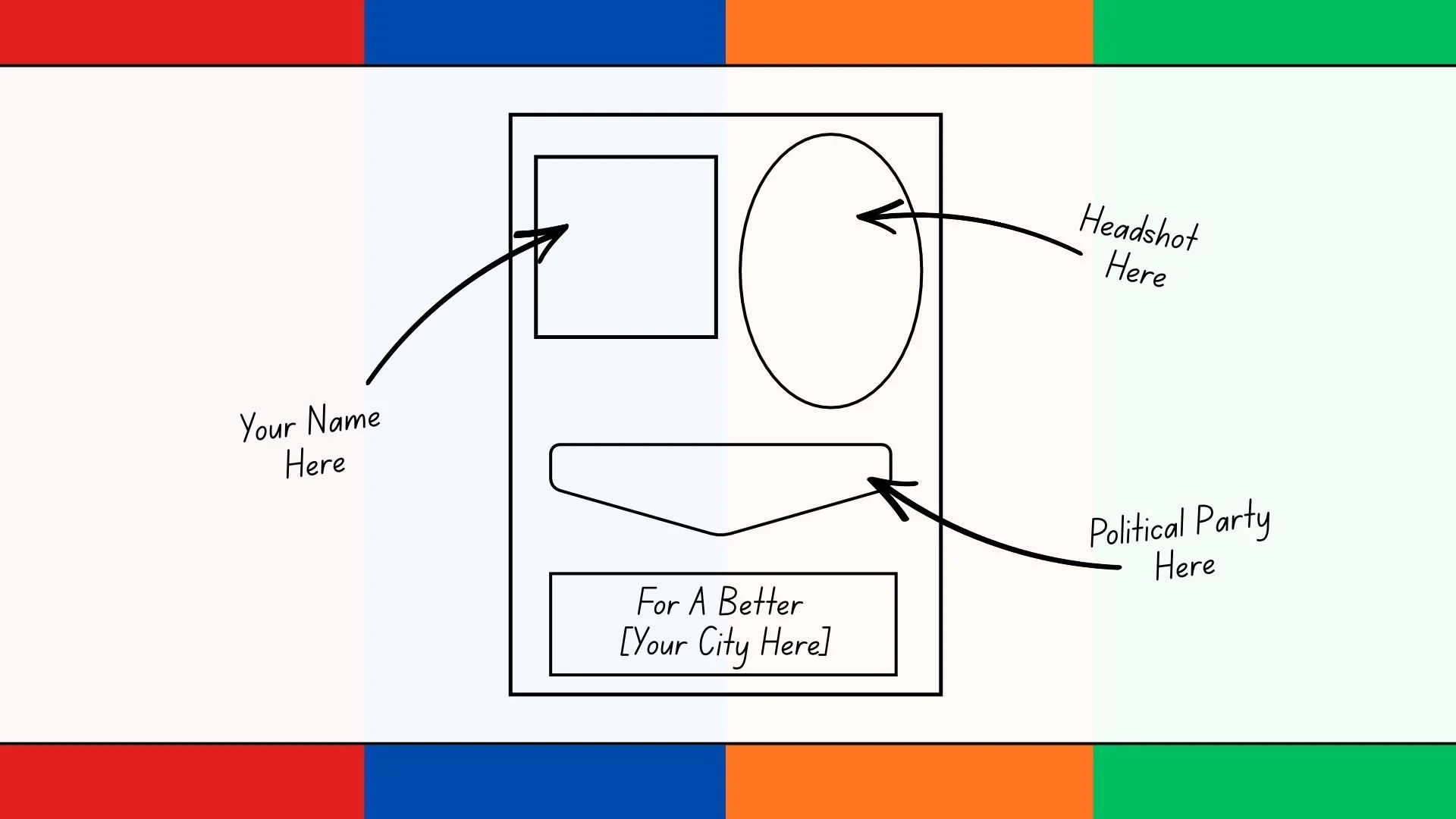
If you live in a Canadian city, you’ve seen the tidal wave of promo that crashes over town whenever an election’s coming up. Suddenly, every lawn, highway median, and telephone pole is plastered in near-identical signage, all formatted the same way. There’s a headshot of a smugly smiling politician, their name in big white letters, a generic slogan (think ‘For a Better [YOUR CITY HERE]’), and a tasteful, colourful element of red, blue, orange, or green to represent their party.
The print materials they send you and the social media ads you get served are rarely much different, almost as if every party hired the same graphic designer to do up their flyers. This style of marketing a candidate is the tradition, and it’s something we’ve come to expect over the years. Other than the research you do and knowing the party your parents usually vote for, this might be the only real promo you ever see before election day. And while a simple billboard with a name, a picture, and a colour might work for, say, Coca-Cola, can we really be expected to recognize a candidate with this marketing approach, let alone feel motivated to vote for them?
A New Kind of Electoral Campaign
It shouldn’t be controversial to say that running an election campaign has changed in the past decade. While you can point to a few different places where this shift may have originated, there’s only one candidate who made the biggest show of breaking the mold and chasing votes differently than their predecessors. We’re, of course, talking about the current sitting US President himself.
Geopolitics has shifted beneath us so much that we sometimes forget to wonder how a washed-up reality TV host, woman abuser, accused child trafficker, and criminal found himself stinking up the Oval Office not once, but twice. And while there are many contributing factors, including a ‘left wing’ that’s just as conservative as the Republicans, a careful stoking of the flames of white nationalism, and the possibility of foreign interference, there’s another element to consider: Marketing.
As much as it pains us to give the MAGA party any credit, it’s undeniable that they understood their audience and how to market online during an election. They appealed to irony-poisoned, terminally online youth, giving credence to their feelings of isolation and doom, and promising them a way out through fascism, nationalism, and hatred as policy.
Likewise, they appealed to the lead-addled brains of older, undereducated generations in rural America, taking the age-old scapegoat of immigrants to whole new levels with preposterous promises. All of it was solidified through symbols and icons rather than tangible policies. Instead of a sensible immigration policy, he promised a border wall. Rather than holding America’s failing social system to account with real plans and actions, he promised to Make America Great Again — whatever that meant. And rather than helping to rebuild American identity and unify its people behind it, he created the red hat, the ultimate symbol of the in-group. Something to rally behind and be a part of, regardless of whether club status really meant a better life for the average person.
The Republican Party’s 2016 campaign marked a monumental shift in the way campaigns are run to this day. It debased the elite snobbery of the typical electoral cycle and made it a spectacle, and for better or worse, it got people involved.
Rethinking Election Campaigns (Without Being Evil)
As the President draws out his plans for his third, fourth, and fifth terms, elections continue to happen around the world. And while the establishment left seems intent on doing everything the same way they always have, we’ve also seen a rise in atypical, interesting campaigns on smaller levels, with more left-wing-aligned candidates using elements of the treacherous MAGA playbook to effect positive change in their communities.
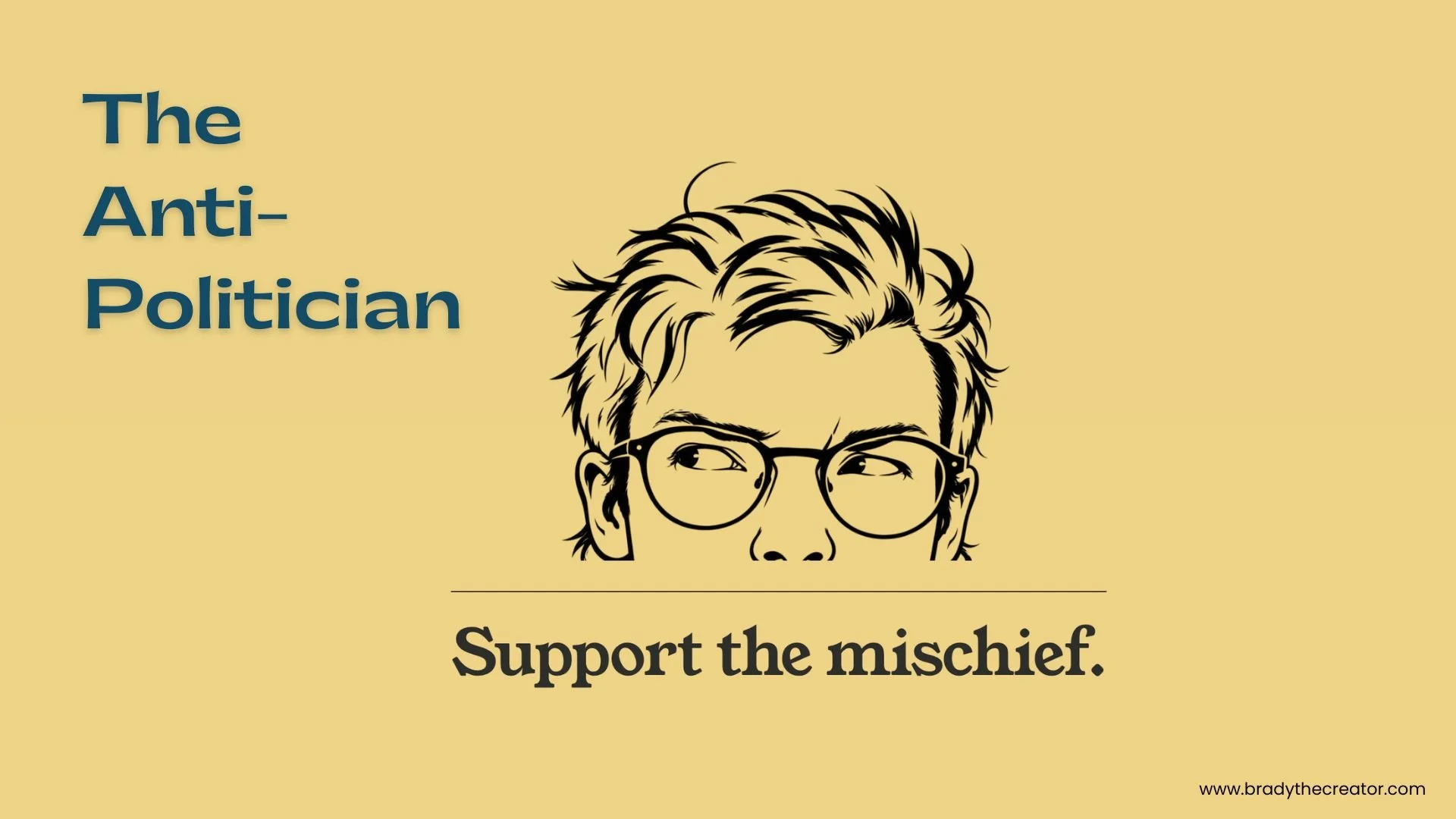
One candidate who’s been on our minds lately is Brady Rogers, who ran a charming, funny, and shockingly successful campaign in Kelowna’s city council election in October of 2026.
His signs stood out first. Among a sea of stuffed-shirt, half-smiling politician headshots, here was Brady, a vision of chill with his messy mullet and ‘Dadlife’ tee. Then you notice his slogans: ‘I BARELY want to do this,’ or ‘Brady Rogers for City Council: I’m just trying to pay my rent.’ His bio on his site is just as irreverent:
‘Do I enjoy politics? No. Do I know what I’m doing? No. But am I qualified? Also no.’
It’s funny, it’s human, it’s the kind of platform you’d dream up with your friends over a few beers on the weekend. Brady was running against establishment candidates — blueheaded career politicians with executive positions and expensive suits. And his only real promise to voters was that he happened to like Kelowna and thought he could help do some good.
Believe it or not, this informal, seemingly slapped-together campaign secured him more than 12,000 votes and won him a seat on Kelowna’s City Council. His response? ‘Thanks, I guess.’
Of course, Brady isn’t some nincompoop who fumbled his way into office. He has real values around supporting small business, housing affordability, and questioning the systems that seem to happen to people, rather than supporting them. He’s a local person who’s getting involved in local government, which is how it was always intended to be.
Brady’s win was no fluke, either. It was the result of extremely effective online marketing aimed at the one demographic that no other candidate seems to care about: The people who don’t vote. His online presence picked up steam over the past year as he created a social media series highlighting an ongoing dispute between the city of Kelowna and the El Dorado resort, which was illegally blocking off a public walkway and seemingly getting away with it.
This was a local issue that actual Kelowna residents dealt with daily. And Brady was willing to speak truth to power, however small, and actually stand up and speak his mind on it. By combining local, high-impact issues with the visibility that a great social media campaign could bring, he was able to build an audience of younger people who would eventually go on to vote him into office.
For another example of this tactic, let’s look south of the border. In the recent mayoral election in New York City, one Democrat candidate made headlines nationwide by rejecting the party’s usual stance of centre-right policy and instead targeting the same demographic as Brady Rogers. We’re, of course, talking about the generational win of Zohran Mamdani.
Mamdani’s campaign was grassroots at every step of the way, with a sharp focus on his audience and the issues that mattered to him, as well as an extremely precise method of reaching them through social media. Whether it was the retro, hand-painted aesthetic of his signs, his universal online presence across platforms, or simply his willingness to make promises of affordability and speak out against injustice, Zohran instantly mobilized an entire demographic that never would have voted for his legacy-politician opponents.
Like, Share, Comment, Vote?
Brady Rogers’ new seat on Kelowna’s city council may not have the same sensational appeal as Zohran’s rise to power in NYC, or the same existential dread as the success of the MAGA party, but the lessons they all learned to win are quite similar.
Rather than continuing to beat the dead horse of traditional campaign marketing, they decided to do something different. They embraced the realities of digital marketing, built real-life audiences out of views and shares, and backed it all up with policies that actually spoke to the people they were trying to reach. Authoritarian governments and fascists leverage social media, AI, and other online spaces to wrest and hold power. These soulless, greedy, egomaniac politicians understand that an investment in marketing is an investment in power. And that means candidates who will actually represent us must jump in the online race and start treating modern marketing as an investment as well.
People, and especially younger voters, are increasingly leaning on AI search to do candidate research, or learning about policies through vertical video instead of campaign flyers and debates. The radical right has already shown that they’re prepared to adapt to this new reality, but lower-level candidates on the left have proven that this tactic can truly earn results. If we’re ever going to vote meaningful change into our communities, candidates will need to reach us, and that means thinking about their campaign like a marketer, not just a politician.